Questions?

REQUEST A MEDICAL SCIENCE LIAISON (MSL)

Questions?

REQUEST A MEDICAL SCIENCE LIAISON (MSL)

Demonstrated Consistent, Long-Term Safety1,2

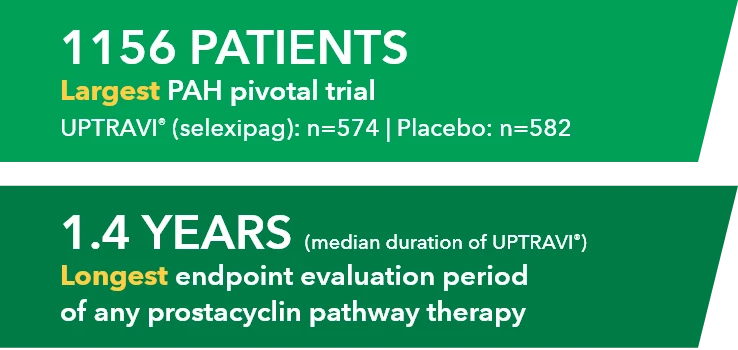
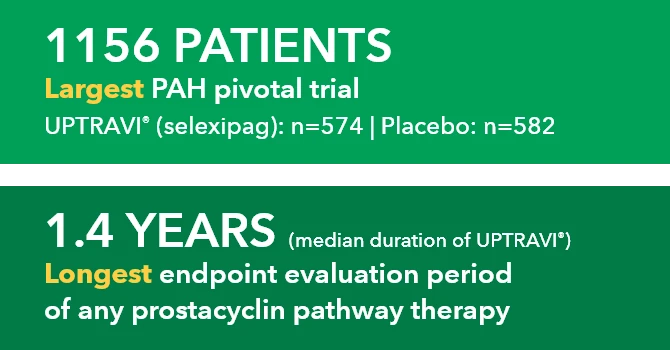
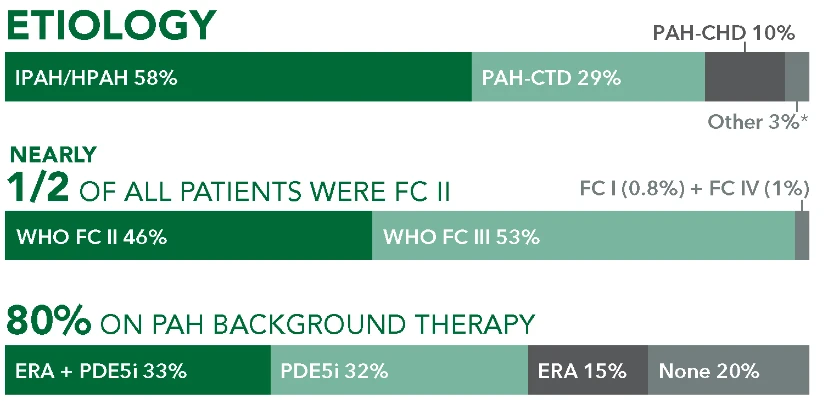
Established across GRIPHON (N=1156) and open-label extension

Adverse reactions occurring more frequently (≥3%) with UPTRAVI® compared with placebo in the GRIPHON trial1

ADVERSE REACTIONUPTRAVI®
n=575
Placebo
n=577
Headache65%32%
Diarrhea42%18%
Jaw pain26%6%
Nausea33%18%
Myalgia16%6%
Vomiting18%9%
Pain in extremity17%8%
Flushing12%5%
Arthralgia11%8%
Anemia8%5%
Decreased appetite6%3%
Rash11%8%

Adverse reactions occurring more frequently (≥3%) with UPTRAVI® compared with placebo in the GRIPHON trial1

ADVERSE REACTIONUPTRAVI®
n=575
Placebo
n=577
Headache65%32%
Diarrhea42%18%
Jaw pain26%6%
Nausea33%18%
Myalgia16%6%
Vomiting18%9%
ADVERSE REACTIONUPTRAVI®
n=575
Placebo
n=577
Pain in extremity17%8%
Flushing12%5%
Arthralgia11%8%
Anemia8%5%
Decreased appetite6%3%
Rash11%8%

Other AEs and laboratory findings of interest3*

ADVERSE REACTIONUPTRAVI®
n=575
Placebo
n=577
Hyperthyroidism1%0%
Hypotension5%3%
Syncope6%9%
Major bleeding event†‡2%2%
Hemoglobin 8 g/dL§1%1%

Pivotal trial overall population: Adverse reactions during the dose adjustment phase1,3

Adverse reactions were more frequent during the titration phase. Once patients reached the maintenance phase, adverse reactions were less frequent.

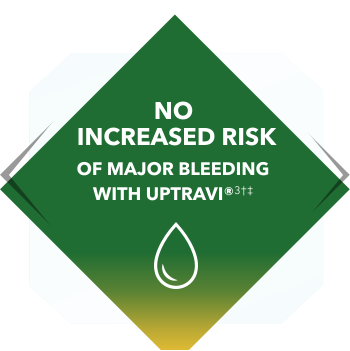
No increased risk of bleeding with UPTRAVI® when administered with oral anticoagulants or platelet inhibitors.4

UPTRAVI®: 10 years of patient impact

VIEW LONG-TERM DATA

*The incidence of AEs of interest that led to discontinuation of the study regimen included the following: hyperthyroidism (none with placebo and 1 with UPTRAVI®), hypotension (2 with placebo and none with UPTRAVI®), syncope (2 with placebo and 1 with UPTRAVI®), and major bleeding event (4 with placebo and 2 with UPTRAVI®). No events of anemia resulted in discontinuation of the study regimen.3

Bleeding events were adjudicated by an independent committee according to the criteria of the International Society on Thrombosis and Haemostasis.3

Major bleeding is defined as fatal bleeding; and/or symptomatic bleeding in a critical area or organ, such as intracranial, intraspinal, intraocular, retroperitoneal, intra-articular or pericardial, or intramuscular with compartment syndrome; and/or bleeding causing a fall in hemoglobin level of 20 g/L (1.24 mmol/L) or more, or leading to transfusion of 2 or more units of whole blood or red blood cells.5

§Hemoglobin values were obtained for 563 patients in the placebo group and for 555 patients in the UPTRAVI® group.3

AE=adverse effect; GRIPHON=Prostacyclin (PGI2) Receptor Agonist In Pulmonary Arterial HypertensiON.

References: 1. UPTRAVI® (selexipag) full Prescribing Information. Actelion Pharmaceuticals US, Inc. 2. Galiè N, Gaine S, Channick R, et al. Long‍-‍term survival, safety and tolerability with selexipag in patients with pulmonary arterial hypertension: results from GRIPHON and its open‍-‍label extension. Adv Ther. 2022‍;‍39(‍1‍)‍:‍796‍-‍810. 3. Sitbon O, Channick R, Chin KM, et al; GRIPHON Investigators. Selexipag for the treatment of pulmonary arterial hypertension. N Engl J Med. 2015;373(26):2522-2533. 4. Data on file. Actelion Pharmaceuticals US, Inc. 5. Schulman S, Kearon C; Subcommittee on Control of Anticoagulation of the Scientific and Standardization Committee of the International Society on Thrombosis and Haemostasis. Definition of major bleeding in clinical investigations of antihemostatic medicinal products in non-surgical patients. J Thromb Haemost. 2005;3(4):692-694.